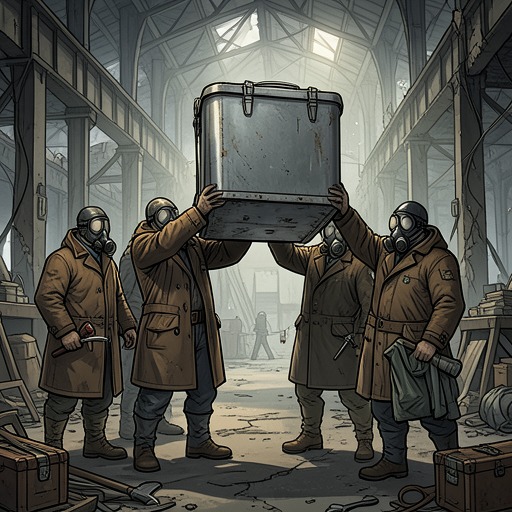
Liquidator
Voices from ChernobylA liquidator is a person assigned to the dangerous work of responding to Chernobyl: clearing debris, handling contaminated material, guarding evacuated villages, or otherwise confronting the consequences of the reactor disaster. The role is not presented as a single uniform job. The testimonies show people arriving by assignment or volunteering, carrying out practical tasks amid uncertainty about radiation, and returning to lives altered by illness and silence. Their labor stands at the heart of a contradiction: a desperate cleanup effort could help limit catastrophe, even as the negligence and secrecy that preceded and accompanied it exposed workers to grave risks.
A role made of different kinds of work
The work ranged from physical cleanup to the enforcement of evacuation. One soldier recalled being ordered to keep former residents out of evacuated villages. His unit erected roadblocks and observation posts while farmers on the other side of the road continued to tend livestock and harvest crops. He had to prevent residents from taking household objects or gathering produce, even as soldiers watched cows graze and harvesters work nearby. The absurdity became intimate and concrete: a woman milked her cow beside a soldier who had to make sure she poured the milk onto the ground; eggs and potatoes had to be buried. The soldier could understand his duty as obedience, but could not make the scene morally or practically intelligible to the people whose land and possessions were being taken from them.
Other workers handled radioactive debris at the reactor itself. One young man, called up after military service and bound by a nondisclosure form, said that he and others carried buckets of graphite and shoveled it with ordinary tools. He described the material as registering ten thousand roentgen, and recalled changing masks as many as thirty times in a shift. The men also poured the sarcophagus over the ruined reactor. For him it became a vast grave, with Valery Khodemchuk, the senior operator trapped beneath the wreckage in the explosion’s first minutes, buried within the ruins. The construction that contained the reactor was thus also bound to the death it enclosed.
The book refuses to reduce such labor to a sequence of spectacular feats. Arkady Filin, impressed into Chernobyl service as a liquidator, remembered a world that remained stubbornly ordinary: men drank vodka, played cards, and tried to meet women. That everydayness does not diminish the danger. It shows how hazardous work was lived as work, threaded through routine social life rather than continually experienced as a heroic tableau.
Orders, volunteering, and the language of heroism
Some workers were sent; others chose to go. One veteran who had served in Afghanistan recalled volunteering for Chernobyl despite having no need for an apartment, car, or other promised benefit. He described the pull as a masculine appeal: men were going to do something important, and those who stayed behind might be seen as hiding. The volunteers included men with pregnant wives, newborn children, and burns. Their choice was real, but it took shape within a culture that made courage, duty, and self-sacrifice powerful expectations.
Another testimony insists that Soviet heroism existed, but rejects the way its public celebration could erase what came before it. Men were praised in daily updates as courageous and selfless; medals and money were awarded. Yet the same speaker argued that the acts of bravery followed incompetence and negligence, and that the orders should never have had to be given. Comparing the men to sand thrown onto the reactor, he turned the language of sacrifice back toward the institutions that had exposed them. Heroism here is neither denied nor allowed to excuse the preventable conditions that demanded it.
The broader emergency accounts make the scale of that ethic visible without making every participant’s job identical. In one account, volunteers repeatedly entered water beneath the reactor to open a safety valve, in an effort to avert a much larger explosion. They were offered substantial material promises, but the testimony stresses that those promises were not why they went. The episode belongs to the book’s wider portrait of self-sacrifice: a culture ready to mobilize people for the impossible, even when the value placed on their lives remained in question.
Exposure and the delayed cost
The danger was often invisible and poorly understood. A worker recalled conflicting advice from scientists about whether the helicopter crew needed protection. The men lined seats with lead and made lead vests, only to learn that such protection did not guard against every kind of radiation. Their days could still feel like ordinary hard work; at night they watched the World Cup on television and talked about soccer. The consequences became apparent later. About three years afterward, one man became sick, then another; someone died, and another person killed himself. The speaker, who had spent two years in Afghanistan and three months at Chernobyl, said the two experiences remained the most memorable of his life, while understanding of Chernobyl’s effects still seemed decades away.
For another soldier, the consequences were immediate in their effect on his life after service. He said that he became a second-group invalid at twenty-two, after returning from the army. His account of carrying radioactive graphite and helping pour the sarcophagus sits beside a separate account of what happened at his factory: when illness affected his work, his boss threatened to reduce his position, and the director replied that the factory had not sent him to Chernobyl. The worker’s claim that he had protected others met an institutional denial of responsibility. The cleanup role could be honored as service in public language and treated as someone else’s problem in ordinary employment.
Cancer also entered the intimate aftermath of the work. Valentina Timofeevna Panasevich’s husband, himself a liquidator, became ill with cancer several years after his stint at Chernobyl. As he was dying, he told her to sell their car and spare tire and not to marry his brother, Tolik. The instruction is painfully domestic: alongside the long aftermath of exposure are possessions to dispose of and a family relationship to navigate. Valentina did not marry Tolik.
Silence, stigma, and the life after service
Secrecy was part of the work’s conditions. The young man who described carrying graphite had signed a nondisclosure form and said that his unit returned without even receiving a change of clothes, wearing the same pants and boots they had worn at the reactor until demobilization. Another worker recalled being warned not to tell people what the team had seen because it was supposedly in the State’s interests. He believed that, apart from those who had gone there, no one knew what had happened, although the workers themselves did not understand everything they had witnessed. Their knowledge was both firsthand and incomplete, held back by orders that made speaking difficult.
Silence persisted after the assignment ended. The worker who had become disabled described being unable to tell his mother what was happening when he lay awake at night, and unable to find anyone who could understand where he had returned from. He also described friends whose bodies changed drastically as they became ill, and his uncertainty about what his own death would be like. These accounts do not turn every worker’s experience into the same medical outcome; instead, they show how uncertainty, sickness, and the absence of a usable record could become part of life after service.
The term must also be distinguished from the broader identity of a person displaced by the disaster. One former resident described becoming a Chernobyl person, treated as an object of curiosity and looked at differently by others. Another family found that people shied away from them after learning they came from Chernobyl; their son was called radioactive at school. A young woman from a Chernobyl family feared that others would regard marriage and having children as unsafe. These accounts concern evacuees and their families, not simply cleanup workers, but they clarify the wider social world in which the liquidator’s identity acquired meaning: the disaster marked people beyond the worksite, while those who had served could be left without a language or public acknowledgment adequate to their experience.
Sacrifice, recognition, and the record
The testimonies hold recognition and abandonment together. Liquidators could receive medals, higher pay, or promises of benefits, yet their own accounts challenge the idea that these rewards settled the debt. One worker described receiving a medal and one thousand rubles; another recalled that men were paid more while on assignment. The same narratives preserve resentment over public assumptions that workers had simply been enriched, as well as the practical difficulty of proving exposure when documents were withheld or classified. Compensation and ceremony did not necessarily provide medical evidence, workplace security, or a way to explain what had happened.
In the larger history recorded by the book, the people who did the work could be both indispensable and expendable. The machines sent into the radiation failed, while human beings continued on the roof and around the reactor. A museum account describes soldiers who understood that their labor had mattered even as they began to die; the record retained their names in documents. The image of human workers taking over where machines could not function does not resolve the moral problem of their sacrifice. It sharpens it: they helped contain a disaster, but the need for their bodies to substitute for failed equipment was itself a consequence to be remembered.
The later political dispute over contamination further complicates what it means to have served. Aleksandr Lukashenka encouraged studies arguing that more land in Belarus was becoming safe for agricultural use. Yuri Bandazhevsky criticized that policy and warned that contaminated food was knowingly being exported; he had been jailed ever since the report described in the book. This conflict is not a measure of any individual liquidator’s exposure, but it shows that the question of what the cleanup achieved—and what risks remained—continued long after the emergency assignments ended. Liquidator therefore names not only a worker in a hazardous operation, but a position in an unresolved history: labor called heroic, bodies left to bear its delayed cost, and testimony struggling against the silence that surrounded both.